
An easement is a legal right for someone other than the owner to use part of a property for a specific purpose, such as running power lines, draining stormwater or reaching a neighbouring lot. You still own the land, but you can’t block that use. For permits, an easement matters because most counties will not let you put a permanent structure on one.
Quick answer: An easement is a recorded right to use part of your land, most often for utilities, drainage or access. You can usually landscape or put a removable fence over it, but sheds, pools, additions and other permanent structures are normally prohibited. Easements are listed on your plat, deed or title commitment and should be shown on your site plan.
Common types of easement
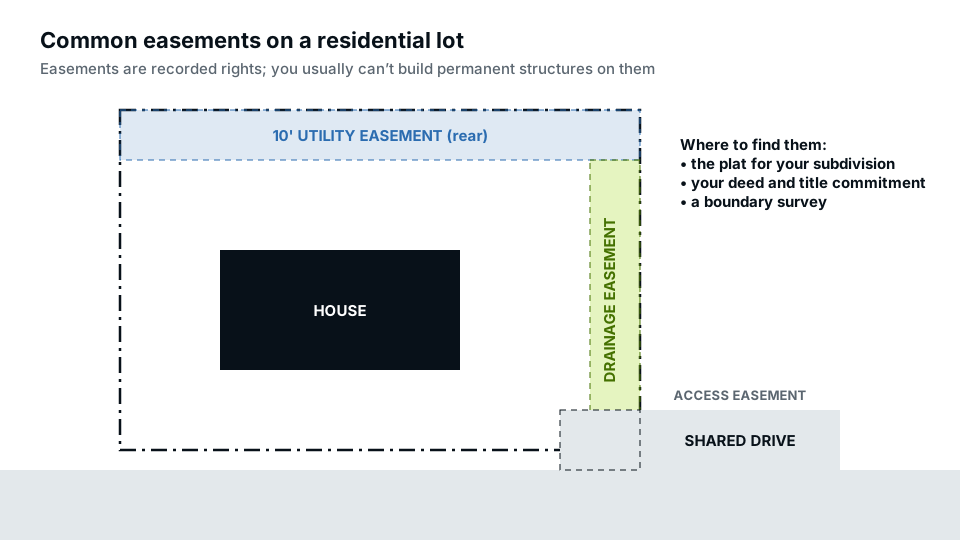
- Utility easements give power, water, sewer, gas or telecom companies room to install and maintain lines. They often run 5 to 10 feet wide along rear or side lot lines in subdivisions.
- Drainage easements keep a path open for stormwater, such as a swale between houses. Blocking one can flood your neighbour, and you.
- Access easements let a neighbour cross your land, for example along a shared driveway to a rear or flag lot.
- Conservation and view easements restrict building to protect land, wetlands or views.
How an easement affects your permit
When you apply for a permit, the reviewer checks your site plan for easements. If the proposed work sits on one, expect the application to be returned. The reasons are practical: a utility company may need to dig up the area, and anything built on top can be removed at the owner’s cost. Typical rules look like this:
| On an easement | Usually allowed? |
|---|---|
| Lawn, planting, gravel | Yes |
| Removable fence | Often, with conditions |
| Driveway or patio | Sometimes, with the easement holder’s consent |
| Shed, deck footings, pool, addition | Usually no |
Because the rules depend on the easement wording and the local code, always check before designing. Our main guide on what a site plan is explains why reviewers check easements alongside setbacks.
How to find easements on your property
- Your plat. Subdivision plats usually show utility and drainage easements as labelled strips along lot lines.
- Your deed and title commitment. Easements that are not on the plat, such as a neighbour’s access right, are listed here.
- A boundary survey. Surveyors plot recorded easements on the drawing.
- The county recorder. Recorded easement documents can be searched by parcel or owner.
- Physical clues. Utility boxes, manhole covers and overhead lines suggest an easement even before you find the paperwork.
Showing easements on your site plan
An easement should appear as a labelled strip with its width, for example “10′ utility easement (per plat)”. The proposed work should be dimensioned to the easement edge as well as to the property line. Reviewers look for this dimension as closely as the setback itself. Our guide on how to read a site plan shows how easements are usually drawn.
What if your project falls inside an easement?
- Move or resize the project so it stays clear. This is usually the quickest fix.
- Ask the easement holder for written consent (an encroachment agreement). Utilities sometimes agree for minor items; they rarely agree to buildings.
- Release or relocate the easement, which is possible but slow and usually needs the holder’s agreement and a recorded document.
When we prepare a permit site plan, recorded easements from the plat or the documents you send are drawn and dimensioned, so problems surface before you submit, not after.
Easements when you buy or sell a home
Easements run with the land, which means they stay in place when the property changes hands. When you buy, your title commitment lists the recorded easements, and it is worth reading them before you plan a pool or an addition, not after. When you sell, an existing structure built over an easement can come up in the buyer’s survey or title review and delay closing.
Some easements are never written down. A prescriptive easement can arise when someone openly uses part of a property, such as a path or driveway, for a long period set by state law. These are less common, but if a neighbour has crossed your land for years, take legal advice before you fence or build across that route.
Easements vs setbacks
They often overlap but are different. A setback is a zoning rule about how far buildings must stay from lot lines. An easement is a property right held by someone else. A shed might meet the 5-foot rear setback and still sit on a 10-foot rear utility easement, and be refused because of it.
Frequently asked questions
Can I build a fence on a utility easement?
Often yes, if it is removable and leaves access, but the utility can take it down to reach its lines. Some easements prohibit fences, so check the wording.
Can a neighbour use my land if there is an access easement?
Yes, for the purpose written in the easement, usually to cross to their property. You can’t block it, but they can’t use it for other purposes.
How wide is a typical utility easement?
Many residential utility easements are 5 to 10 feet wide, but widths vary. Your plat or easement document gives the exact figure.
Do easements show up on a title search?
Recorded easements normally appear in the title commitment. Unrecorded or prescriptive easements may not, which is one reason to look for physical clues too.
Can I put a shed on an easement if it has no foundation?
Usually not. Most codes and easement documents treat any building as a permanent structure, whether or not it sits on a slab. A small portable item may be tolerated, but the easement holder can still require you to move it, so plan the shed outside the easement strip.
Who maintains the land inside an easement?
Normally the owner does: you mow, plant and keep it tidy. The easement holder maintains its own equipment, such as pipes or lines, and may disturb the surface when it needs access.