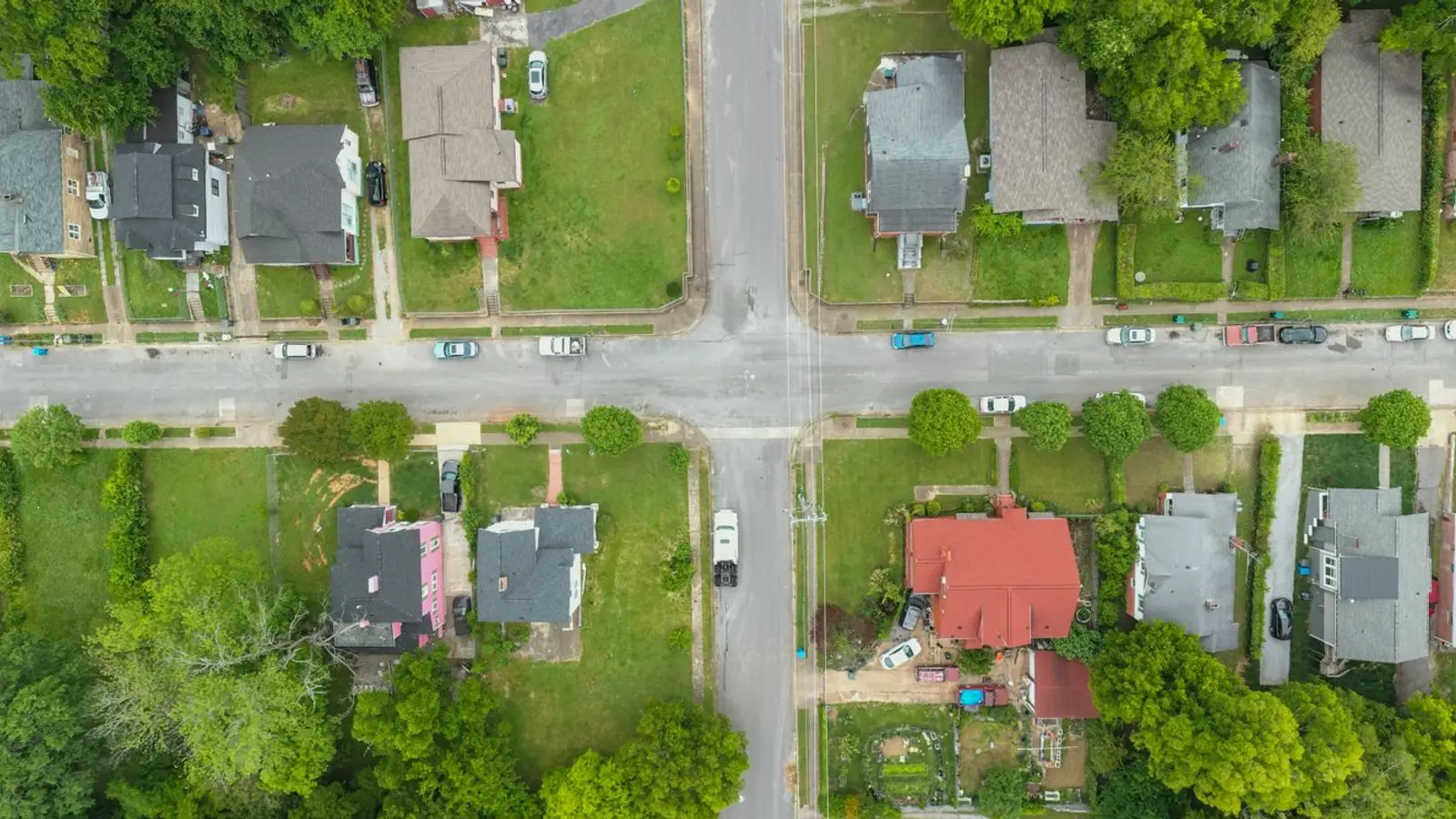

Corner lot setbacks are stricter than those on a typical interior lot because the property faces two streets. Many zoning codes treat both street sides as fronts, add a sight triangle at the corner, and restrict fences and hedges along the street side. If you own a corner lot, these rules can shrink your buildable area and change where a fence, garage or addition can go.
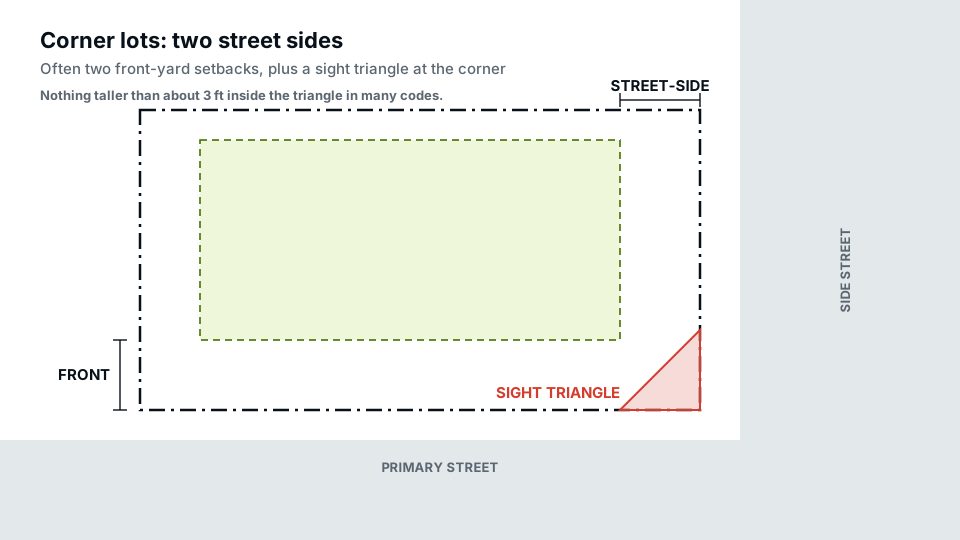
Quick answer: Corner lots usually have a full front setback on the primary street and either a second front setback or a slightly smaller “street-side” setback on the other street. A sight triangle at the intersection limits anything above roughly 2.5 to 3 feet, such as fences and hedges. The exact numbers come from your local zoning code.
Why corner lots get extra setbacks
Corner lots sit where traffic turns and crosses. Codes keep buildings back from both streets to preserve sight lines for drivers and pedestrians, to keep the building line consistent along both blocks, and to avoid tall walls right at the sidewalk on two sides. The trade-off is that a corner lot often has less buildable area than an interior lot of the same size. The basics of setbacks are covered in our pillar guide on setback requirements.
How codes define the front of a corner lot
Codes take one of three approaches:
- Two fronts. Both street sides must meet the full front setback. This is the most restrictive.
- Front plus street side. One side (often the narrower frontage, or the side the house faces) is the front; the other has a reduced street-side setback.
- Owner’s choice. Some codes let the owner designate the front, after which the other side becomes a street side.
The two remaining sides are then treated as side yards, or as one side and one rear, depending on the code. This matters for sheds and garages, which are often allowed only in the rear yard.
The sight triangle
A sight triangle (also called a vision triangle or clear sight area) is a triangular area at the corner, formed by measuring a set distance along each street line from the corner and joining the two points. Inside it, codes typically prohibit fences, walls, hedges, signs and parked vehicles above a low height, often around 2.5 to 3 feet, so drivers can see cross traffic.
The size of the triangle varies. It may be measured from the property lines or from the curb lines, and it can be larger where a driveway meets the street. Our guide on the corner lot fence sight triangle focuses on fence rules inside it.
What corner lot setbacks mean for common projects
| Project | Corner lot issue |
|---|---|
| Fence | Front-yard height limits may apply along both streets; nothing tall in the sight triangle |
| Addition | Street-side setback can block expansion toward the side street |
| Detached garage | May need to meet street-side setback if it faces the side street; driveway sight lines |
| Shed | “Rear yard only” rules depend on which side the code calls the rear |
| Pool | Barrier fences near the street-side line must meet both fence and barrier rules |
Showing corner lot setbacks on your site plan
- Label both streets and identify which side is the front.
- Draw both street setbacks and dimension the new work to each street line.
- Draw the sight triangle with its dimensions, and show anything inside it with its height.
- For fences, give the height of each run, especially within the front and street-side yards.
Setback distances on corner lots are measured the same way as elsewhere, from the property line at right angles; our guide on how setbacks are measured covers the details. A site plan drawn this way answers the reviewer’s corner-lot questions before they are asked.
Getting relief on a corner lot
Because corner lots can be hard to build on, some codes offer relief: a reduced street-side setback for narrow lots, allowing the owner to choose the front, or an administrative adjustment for small deviations. If none applies, a variance may be possible where the corner location creates a genuine hardship; see our guide to the zoning variance process.
Driveways and garages on corner lots
Corner lots raise a second sight-line issue: driveways. Many codes require a driveway to sit a minimum distance from the intersection, so cars entering and leaving don’t conflict with turning traffic. Some also set a separate sight triangle where the driveway meets the sidewalk. If you plan a garage that opens onto the side street, check both the street-side setback and the driveway spacing rules, as either can decide where the garage door can go.
Buying a corner lot? Check before you commit
If you are looking at a corner lot with plans for a pool, a large garage or an addition, check the setbacks and sight triangle rules before buying. Sketch the buildable area on the plat. What looks like a generous side yard may be almost entirely within the street-side setback.
Frequently asked questions
Does a corner lot have two front yards?
Often, yes. Many codes treat both street sides as fronts; others treat one as a front and the other as a street side with a smaller setback.
How tall can a fence be on a corner lot?
It depends on where it is. Front-yard height limits often apply along both streets, and inside the sight triangle the limit is usually very low, around 2.5 to 3 feet.
Which side is the rear yard on a corner lot?
The code defines it, usually opposite the designated front. This matters for sheds and garages that are allowed only in the rear yard.
Can I plant a hedge in the sight triangle?
Usually only if it is kept below the height limit. Taller planting, fences and walls inside the triangle are normally prohibited.
Are corner lots worth more or less?
It depends on the market, but buyers should factor in the extra setbacks, the sight triangle and the traffic on two sides. A corner lot can feel larger yet offer less buildable space for additions, pools or garages.