
A sight triangle is the area at a street corner where fences, walls, hedges and other obstructions are limited, so drivers can see approaching traffic and pedestrians. If you own a corner lot, it is the rule most likely to shape your fence. Codes define the triangle differently, but the idea is the same everywhere: keep the corner low and open.
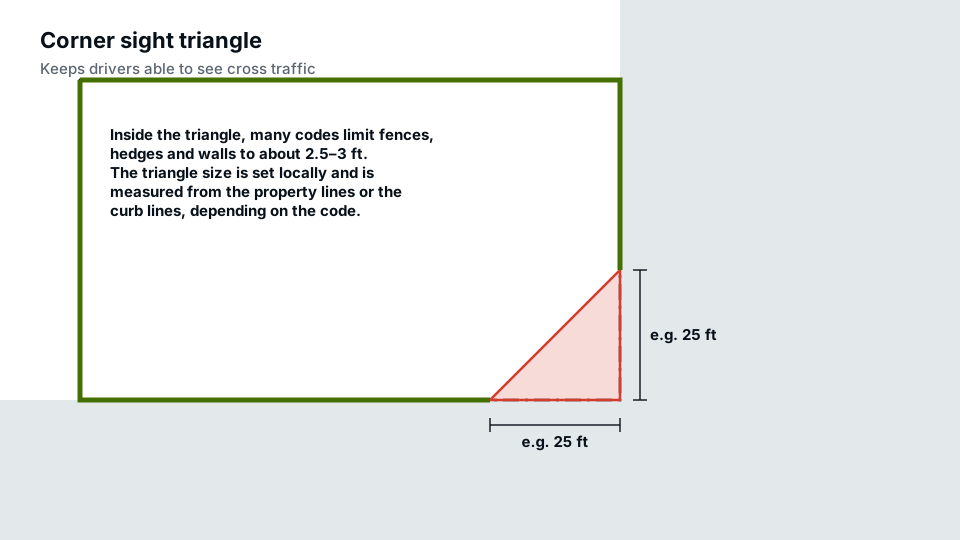
Quick answer: A sight triangle is formed by measuring a set distance along each street or property line from the corner and joining the two points. Inside it, fences, walls and planting are usually limited to around 2½ to 3 feet high, though trees may be allowed if trimmed up. Many codes also define smaller sight triangles at driveways.
How a sight triangle is measured
Codes use one of several reference points:
- Property lines: measure a set distance along each front property line from where they meet.
- Curb lines or edges of pavement: measure from where the curbs would intersect.
- Street centrelines: used in some codes for larger triangles.
The distances vary widely, from about 10 feet to 30 feet or more, and are often larger at busier streets. Join the two points with a straight line, and the triangle between that line and the corner is the restricted area.
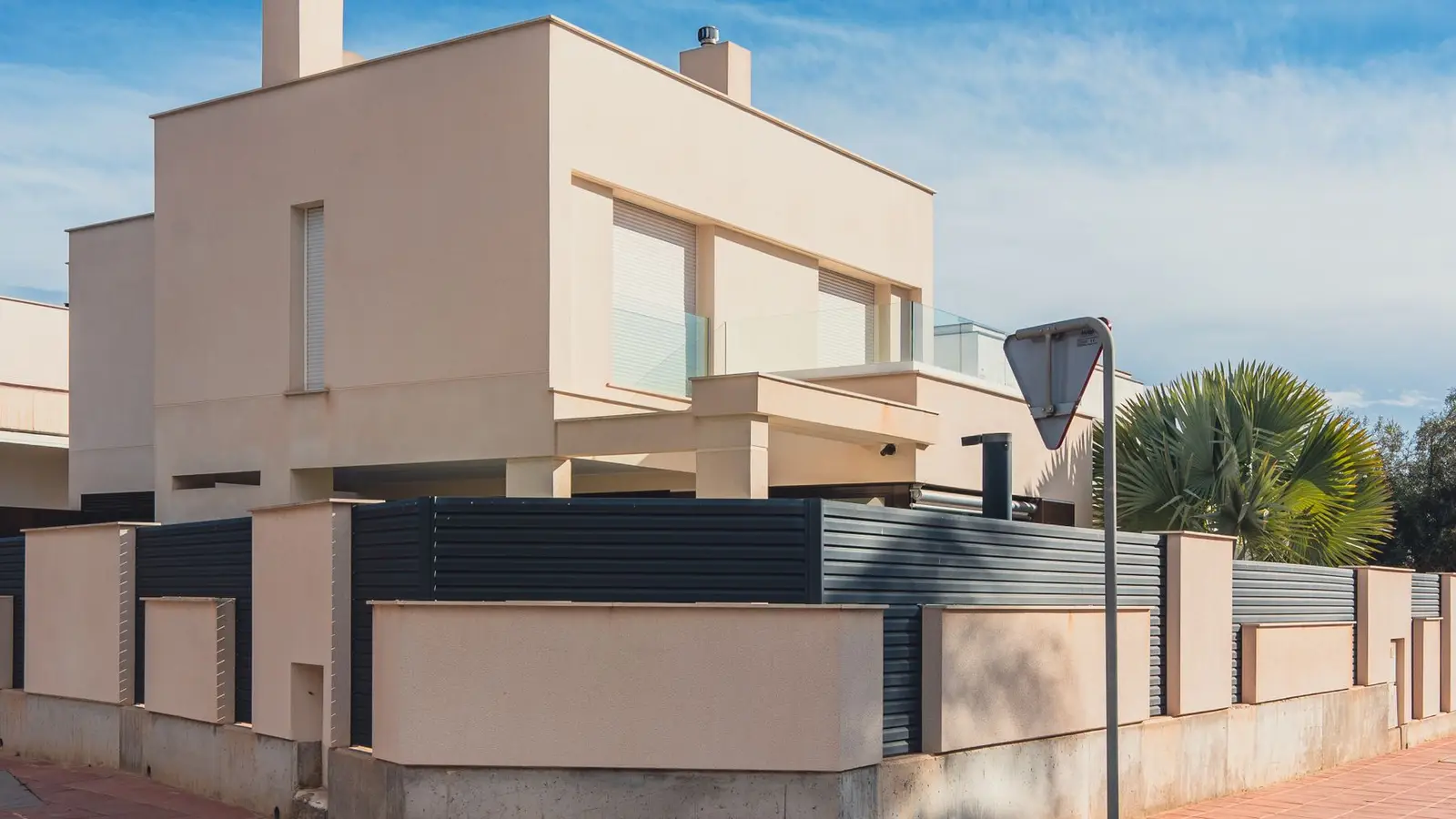
For how corner lots affect other rules, see our guide on corner lot setbacks, and for fences generally, our pillar fence permit guide.
What is allowed inside the sight triangle
| Item | Typical rule |
|---|---|
| Fences and walls | Limited to a low height, often 2½ to 3 ft |
| Hedges and shrubs | Same low height limit, maintained |
| Trees | Often allowed if branches are trimmed above about 7 to 8 ft |
| Signs, mailboxes, utility boxes | Restricted or allowed if narrow |
| Parked vehicles | Sometimes restricted on private driveways near the corner |
The height band between the low limit and the tree canopy is kept clear so a driver’s eye line, roughly 3½ feet above the road, can see across the corner.
Driveway sight triangles
Many codes also define small triangles where a driveway meets the sidewalk or street, so drivers backing out can see pedestrians. These are often measured as a few feet along the driveway edge and the property line. A tall privacy fence right up to the driveway may violate them. Show driveway triangles on your site plan if your code has them.
Corner lots and front-yard fence rules
Corner lots have two street frontages. Many codes treat both as front yards, at least for part of their length, so lower front-yard fence heights apply on the street side. Others treat one frontage as a “side street” yard with its own rules, sometimes allowing a taller fence set back from the sidewalk. This is often where corner-lot owners lose the most privacy. Our guide to fence height limits explains how yards are defined.
Planning a corner lot fence
- Find the sight triangle dimensions and reference points in your code.
- Locate the property lines and curbs at the corner.
- Draw the triangle on your site plan.
- Keep the fence low, or start it outside the triangle.
- Check the street-side yard height rules for the rest of the run.
- Mark driveway triangles too.
A common layout is a low or open fence at the corner, angling or stepping to a taller privacy fence behind the house and outside the triangle.
A worked example
Suppose your code defines the sight triangle by measuring 25 feet along each front property line from the corner, with a 30-inch height limit inside it. Your lot has 60 feet of frontage on Oak Street and 100 feet on Elm Street. On the site plan, mark points 25 feet from the corner along both lines and connect them. A 6-foot privacy fence along the Elm Street side can’t start at the corner; it might begin at the edge of the triangle, if the street-side yard rules allow that height, or it might step down to a 30-inch open fence inside the triangle. If your driveway on Oak Street also has a 10-foot driveway triangle, the fence must stay out of that area too.
Who enforces sight triangles
Sight triangles are enforced by the zoning office, and often by the public works or traffic department. Because they are a safety rule, enforcement can be stricter than for other fence issues, and existing fences or hedges that block the view can be cited even if they predate the rules. The right-of-way strip between your property line and the curb belongs to the public, and fences there are usually prohibited.
Common mistakes
- Measuring the triangle from the curb when the code uses property lines, or the reverse.
- Letting hedges inside the triangle grow above the limit.
- Building a solid fence up to the driveway, blocking the driveway triangle.
- Treating the street side of a corner lot as a side yard when the code treats it as a front yard.
- Placing the fence in the public right-of-way.
Showing the sight triangle on your fence permit
Reviewers want to see the triangle drawn and dimensioned, with a note of the height limit inside it and the fence height at each run. Our fence permit site plans draw sight triangles on every corner lot, and our general site plans include them where any project is near a corner.
Frequently asked questions
What is a sight triangle?
The area at a corner where fences, walls and planting are kept low so drivers can see traffic and pedestrians.
How big is a sight triangle?
It varies by code, commonly measured 10 to 30 feet or more along each line from the corner.
Can I have a tree in the sight triangle?
Often yes, if its branches are trimmed high enough to keep the view clear.
Do sight triangles apply to driveways?
Many codes include smaller triangles at driveways. Check your local rules.
Can an existing hedge be cited?
Yes. Sight triangle rules often apply to existing planting that blocks the view.