
Fence height limits are set by your local zoning code and almost always vary by location on the lot. Front-yard fences are kept low so streets stay open and drivers can see; side and rear fences can be taller for privacy. The details, such as how height is measured, whether posts and lattice count, and what happens on slopes, decide whether your fence passes review.
Quick answer: Common fence height limits are 3 to 4 feet in front yards and 6 feet in side and rear yards, with some codes allowing 7 or 8 feet at the rear. Height is usually measured from the grade at the fence line to the top of the fence. Fences on retaining walls, lattice toppers and post caps may count toward height, depending on your code.
Fence height limits by yard
Codes divide the lot into yards. The front yard is usually the area between the street and the front of the house, though some codes use the front setback line instead. Side yards run along the sides; the rear yard is behind the house.
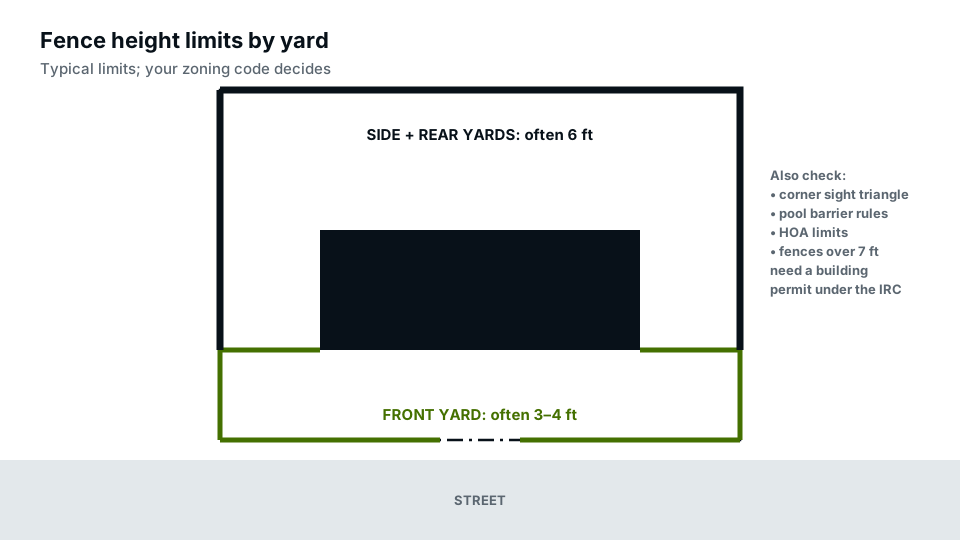
| Yard | Typical limit |
|---|---|
| Front yard | 3 to 4 ft, often with an openness requirement |
| Side yard in front of the house | Same as front yard |
| Side yard behind the front of the house | 6 ft |
| Rear yard | 6 ft; some codes allow 7 or 8 ft |
| Next to a commercial or industrial use | Often taller allowed |
These are common patterns, not rules for your lot. For the full picture, see our pillar fence permit guide.
How fence height is measured
Most codes measure from the finished grade at the fence line to the top of the fence. The details vary:
- Which side: where grade differs on each side, some codes measure from the higher side, others from the lower side or the owner’s side.
- Posts and caps: some codes allow posts and decorative caps to exceed the fence height by a few inches.
- Lattice and toppers: usually count toward total height.
- Gaps at the bottom: a gap above grade still counts in the measurement from grade.
- Berms: a fence on an artificial berm may be measured from the original grade.
Fences on slopes
On sloping lots, fences are either stepped (each panel level, stepping down the slope) or racked (panels following the slope). With stepped fences, the high corner of each step can exceed the limit while the low corner is under it. Many codes allow an average or a small tolerance at steps; others require every point to be within the limit. Show the grade and the fence profile on an elevation if your lot slopes noticeably.
Fences on retaining walls
A fence on top of a retaining wall often has its height measured from the lower grade, so the wall height counts. A 6-foot fence on a 3-foot wall may be treated as a 9-foot structure. Some codes measure from the upper grade instead, or allow a combined height with a setback between the wall and fence. Check carefully, and see our guide to retaining wall permits if the wall itself is significant.
Openness rules in front yards
Many codes say front-yard fences must be a certain percentage open, such as at least 50% open, so a picket, rail or ornamental metal fence is allowed where a solid board fence isn’t. Some allow taller front fences if they are mostly open. Hedges and planting may have their own limits, especially near corners, as explained in corner lot sight triangles.
Building code limits on fence height
Under the International Residential Code, fences over 7 feet need a building permit, because tall fences must resist wind loads. If your zoning allows an 8-foot fence, you may still need a building permit with post and footing details. Masonry walls often need a building permit at lower heights.
Getting approval for a taller fence
If you need more height than the code allows, the options are:
- Move the fence back. Some codes allow taller fences further from the street or property line.
- Use planting. Trees and shrubs often aren’t limited in rear yards, though they may be at corners.
- Apply for a variance or administrative adjustment where the lot has a specific hardship, such as backing onto a busy road. See zoning variance.
- Check for exceptions for lots next to commercial uses, highways or rail lines.
Common fence height mistakes
- Building a 6-foot fence forward of the front of the house.
- Adding a lattice topper to a 6-foot fence, making it 7 feet.
- Ignoring the retaining wall below the fence.
- Assuming the neighbour’s taller fence means yours is allowed.
- Forgetting that the street side of a corner lot is treated like a front yard.
Showing fence height on your site plan
A clear fence site plan labels each fence run with its height and material, marks gates, and uses a legend or colour to separate different heights. Add a typical elevation showing height measured from grade. Our fence permit site plans colour-code each height so the reviewer can confirm compliance at a glance.
Frequently asked questions
What is the maximum fence height for a backyard?
Commonly 6 feet, with some codes allowing 7 or 8 feet. Check your zoning district.
Do fence posts count toward fence height?
Some codes allow posts and caps a few inches above the limit; others count the highest point.
Can I put lattice on top of a 6-foot fence?
Usually only if the total stays within the height limit. Lattice typically counts.
How is fence height measured on a slope?
Usually from the grade at the fence line. Stepped fences may get a small tolerance at each step, depending on the code.
Can I get a permit for an 8-foot fence?
Where zoning allows it, yes, and fences over 7 feet usually need a building permit too.
Do hedges have height limits?
In rear yards they often don’t, but hedges in front yards and corner sight triangles commonly have the same limits as fences.