
A flag lot is a lot shaped like a flag on a pole: the main buildable area (the flag) sits behind other lots, connected to the street by a long, narrow strip (the pole) used for the driveway and utilities. Flag lots are a common way to split deep lots, but they raise questions about access, privacy, fire safety and utilities, so many codes regulate them closely and some prohibit new ones.
Quick answer: A flag lot has a narrow access strip to the street and its buildable area behind other lots. Codes that allow them typically set a minimum access strip width, require the main portion to meet minimum lot area (often excluding the strip), apply special setbacks, and require driveway and fire access standards. Some jurisdictions don’t allow new flag lots at all.
Anatomy of a flag lot
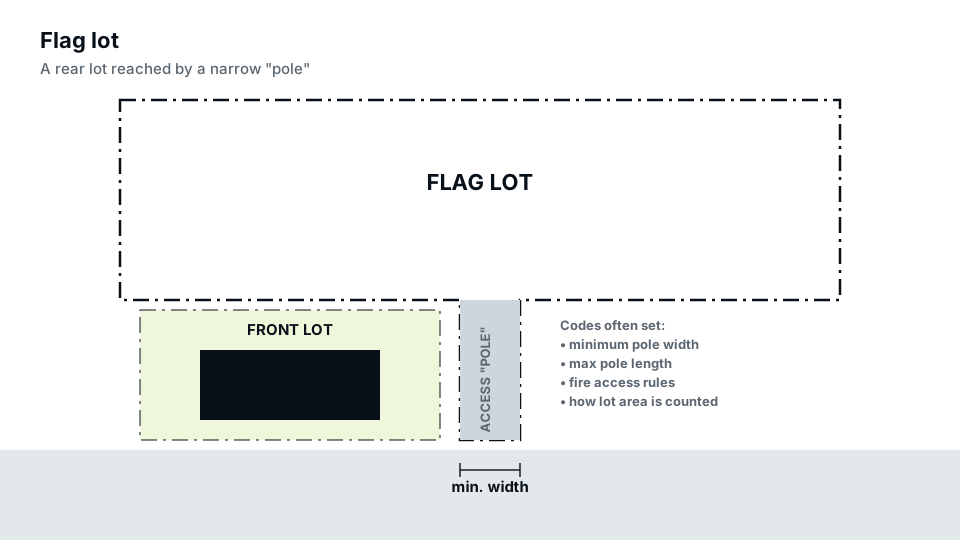
| Part | Role |
|---|---|
| Access strip (pole) | Driveway, utilities and frontage |
| Main lot (flag) | Where the house and yard go |
| Front lot | The lot the flag sits behind |
For how flag lots are created, see our pillar how to split a lot.
Why codes regulate flag lots
- Fire trucks and ambulances need to reach the rear house.
- Utilities must run the full length of the strip.
- Rear houses can affect neighbours’ privacy.
- Long, narrow driveways raise parking and turnaround issues.
- Too many flag lots can change a neighbourhood’s character.
Common flag lot rules
- Minimum access strip width: often in the range of about 15 to 25 feet, wider if serving more than one lot.
- Maximum strip length: sometimes limited for fire access.
- Lot area: often measured excluding the access strip.
- Setbacks: the code may define which line is the “front” and set uniform setbacks on all sides.
- Number of flag lots: limits on how many can share a strip or exist side by side.
- Driveway standards: surface, width, turnaround and grade.
- Address visibility from the street.
These are typical patterns; check your code’s exact numbers. See minimum lot size and frontage.
Setbacks on flag lots
On a normal lot, the front setback faces the street. On a flag lot, the “front” may be defined as the line closest to the street, the line where the strip meets the flag, or the code may simply apply side setbacks on all sides. This affects where the house can go and how big it can be. Read the definitions; see setback requirements.
Fire and emergency access
Fire codes often require a fire apparatus access road within a set distance of all parts of a building. Long flag lot driveways may need to meet road standards for width, surface and turning space, or the house may need sprinklers. Ask the fire marshal early.
Utilities
Water, sewer, power and communications run down the access strip. The strip must be wide enough for the driveway and utilities with required separations. Sewer slope to the street can be a constraint for rear lots lower than the street.
Shared access and easements
Some codes allow access by easement across the front lot instead of an owned strip, or a shared driveway serving several lots. Shared driveways need recorded maintenance agreements covering repairs, snow removal and costs. See what is an easement.
Buying a flag lot
Flag lots can offer privacy and quiet, often at a lower price. Before buying, check that the lot is legally created and recorded, the access strip meets current width rules or is grandfathered, fire access works for your planned house, utilities are available, and any shared driveway has a recorded agreement.
Creating a flag lot
- Confirm flag lots are allowed in your district.
- Check that both resulting lots meet area, width and frontage rules.
- Design the access strip for width, driveway and utilities.
- Confirm the existing house meets setbacks from the new lines.
- Consult the fire marshal and utilities.
- Hire a surveyor for the plat; see what is a plat.
Driveways on flag lots
The access strip carries the driveway, so its design matters. Codes may set a minimum paved width, a maximum grade, a turnaround near the house for emergency vehicles, and passing areas on very long driveways. Drainage from the long driveway must not flow onto neighbouring lots. Snow storage, mailboxes and trash collection at the street are practical points that buyers notice. If the strip is shared, the maintenance agreement should cover all of these.
Privacy and design
A house on a flag lot often looks into the rear yards of the front lot and its neighbours. Some codes respond with larger setbacks, height limits or window placement rules for flag lots. Even where not required, thoughtful placement of windows, decks and landscaping reduces friction with neighbours and makes the flag lot more pleasant to live on.
Alternatives to a flag lot
- An ADU on the existing lot, without splitting; see our ADU permit guide.
- A side-by-side split if the lot is wide enough.
- A lot line adjustment with a neighbour.
Common problems
- Access strip narrower than required.
- Main lot area short once the strip is excluded.
- Fire access distance too long.
- Sewer can’t flow by gravity.
- No shared driveway agreement.
Concept layouts
Our subdivision plans service tests flag lot layouts against your code before you commission a survey.
Frequently asked questions
What is a flag lot?
A lot with a narrow access strip to the street and the main area behind other lots.
How wide must a flag lot access strip be?
It depends on the code; widths around 15 to 25 feet are common.
Does the access strip count toward lot area?
Many codes exclude it. Check your definitions.
Are flag lots allowed everywhere?
No. Some jurisdictions prohibit new flag lots.
Can two flag lots share one access strip?
Some codes allow it with a wider shared strip and a recorded maintenance agreement; others limit each strip to one lot.
Can I build a house on an existing flag lot?
Usually, if it was legally created and meets setbacks and access rules.