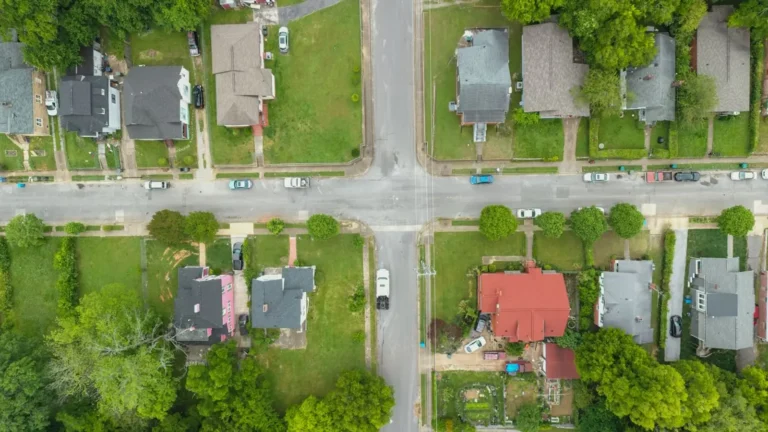

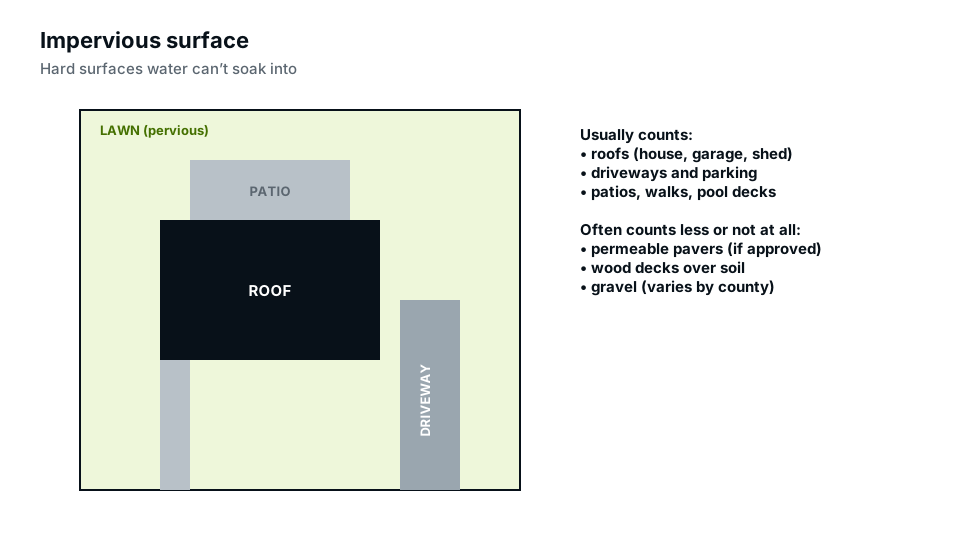
An impervious surface is any hard surface that stops rainwater soaking into the ground: roofs, driveways, patios, walks and pool decks. Many cities and counties limit the share of a lot that can be impervious, and they increasingly check it on permit applications for driveways, patios, additions and pools. It is one of the most common reasons a “simple” paving project needs a site plan.
Quick answer: Impervious surface coverage is the total area of roofs and hard paving divided by the lot area. Roofs, concrete, asphalt and standard pavers almost always count. Gravel, wood decks over soil and approved permeable pavers may count less or not at all, depending on your local code. Many codes cap the total or require stormwater measures above a threshold.
Why impervious surface is regulated
Hard surfaces send rain straight into gutters, streets and storm drains instead of letting it soak in. More runoff means more flooding, erosion and pollution downstream, and more load on public drainage systems. Limiting impervious area keeps more water on each lot. It is a stormwater rule as much as a zoning rule, and it sits alongside the building coverage limit explained in lot coverage.
What counts as impervious surface
| Surface | Usually |
|---|---|
| Roofs (house, garage, shed) | Counts |
| Concrete and asphalt driveways, walks, patios | Counts |
| Standard pavers on a compacted base | Counts |
| Pool decks and pool coping | Counts |
| Pool water surface | Varies by code |
| Gravel | Varies; often counts if compacted for parking |
| Wood decks with gaps over soil | Often excluded or partly counted |
| Engineered permeable pavers | Often counted at a reduced rate if approved |
| Lawn, planting beds, mulch | Does not count |
How to calculate impervious surface coverage
- Find the lot area from your survey, plat or parcel record.
- Measure every impervious area: roof footprints, driveway, walks, patios, pool decks, sheds and parking pads.
- Add the proposed new surfaces and subtract any you will remove.
- Divide the total by the lot area and multiply by 100.
- Compare with your code’s limit, and with any threshold that triggers stormwater requirements.
Example: a 7,000 sq ft lot with a 2,240 sq ft roof area, a 600 sq ft driveway, a 300 sq ft patio and 160 sq ft of walks has 3,300 sq ft impervious, or about 47%. Adding a 400 sq ft driveway extension brings it to 3,700 sq ft, about 53%.
Permeable pavers and other alternatives
Permeable systems let water drain through the surface into a stone base. Many codes credit them, but usually only if they are designed and installed to a standard, sometimes with an engineer’s or manufacturer’s documentation, and maintained so the joints don’t clog. Some codes give full credit, some partial, and some none. Ask before you buy materials. Other options include gravel (where allowed), ribbon driveways with grass between the strips, and wood decks with open gaps over soil.
Stormwater thresholds
Beyond a straight limit, many jurisdictions require stormwater management once new impervious area exceeds a threshold. That can mean rain gardens, dry wells, cisterns or downspout disconnection, sometimes with a small grading or drainage plan. Projects in flood-prone or sensitive watershed areas often face lower thresholds.
What reviewers want on the site plan
- Every impervious area drawn and labelled with its size.
- Existing and proposed areas listed separately.
- A table with the totals, the percentage and the limit.
- Material notes for any permeable surfaces.
- Drainage direction, especially for driveways and patios near property lines.
Our driveway permit site plans include an impervious area table by default. For how impervious limits fit into your district’s rules, see our pillar guide on finding your property zoning.
Impervious surface on common projects
Most homeowners first meet an impervious surface limit on one of these projects:
| Project | What adds up |
|---|---|
| Driveway widening or new parking pad | The full new paved area, plus any apron in the right-of-way if your code counts it |
| Patio or outdoor kitchen | The slab or pavers, plus any roofed area over it |
| Pool | Pool deck, coping, equipment pad and sometimes the water surface |
| Detached garage | The roof plus the new driveway leading to it |
| Addition | The new roof area; sometimes new walks too |
Garages are a common surprise: the building may fit within lot coverage, but the long driveway to reach a rear garage can push impervious coverage over the limit.
Drainage matters as much as the total
Even when your total is within the limit, reviewers look at where the water goes. A new driveway or patio that slopes toward a neighbour’s lot can be refused or require changes. Expect questions if paving comes close to a side lot line, if the lot slopes toward a neighbour, or if downspouts are piped onto paving that drains off the property. Arrows on the site plan showing the direction of flow, and a note on where downspouts discharge, answer most of these questions before they are asked.
Reducing impervious surface on your lot
- Narrow an oversized driveway, or replace part of it with permeable pavers.
- Replace a solid patio with a slatted deck over soil, if your code credits it.
- Remove unused walks or slabs.
- Choose a smaller pool deck or a permeable deck surface.
Frequently asked questions
Is gravel considered impervious?
It depends on the code. Compacted gravel used for parking is often counted; loose decorative gravel over soil may not be.
Do permeable pavers count as impervious surface?
Many codes count them at a reduced rate or exclude them if they meet design standards. Some count them fully. Check before choosing.
Does a pool count as impervious surface?
Pool decks and coping almost always count. The water surface itself is treated differently in different codes.
Why does my driveway permit need a site plan?
Because the reviewer needs to check impervious area, drainage direction and the connection to the street, all of which are shown on the site plan.
Is impervious surface the same as lot coverage?
No. Lot coverage usually counts buildings only; impervious coverage counts all hard surfaces.