
Minimum lot size rules set the smallest area a lot can have in a zoning district, and companion rules set minimum width, depth and street frontage. Together they decide whether a lot is buildable, whether it can be split, and what shape new lots can take. They are often written into the district name itself, such as RS-7 for a 7,000 sq ft minimum, and they are the first numbers to check before buying land or planning a lot split.
Quick answer: Minimum lot size is the smallest lot area allowed in a zoning district. Codes also set a minimum lot width (often measured at the front setback line), minimum depth and minimum street frontage. New lots must meet all of them; existing smaller lots may be legal nonconforming and buildable under special rules.
The four dimensional minimums
| Rule | What it means | Typically measured |
|---|---|---|
| Minimum lot area | Total square footage or acreage | Within the lot lines, sometimes excluding right-of-way or easements |
| Minimum lot width | How wide the lot is | At the front setback line or building line |
| Minimum frontage | Length along a public street | Along the front lot line |
| Minimum depth | Distance from front to rear | Average or at the centre of the lot |
For how these apply to dividing land, see our pillar how to split a lot.
Typical minimum lot size patterns
Numbers vary enormously between places. As patterns:
- Urban single-family districts: small lots, sometimes a few thousand square feet.
- Suburban districts: commonly several thousand to around 10,000–20,000 sq ft.
- Rural residential: often one acre or more.
- Agricultural: often many acres.
- Septic areas: health rules may require larger lots for septic systems.
Use your own code; these are only illustrations. See how to find your property zoning.
How lot width is measured
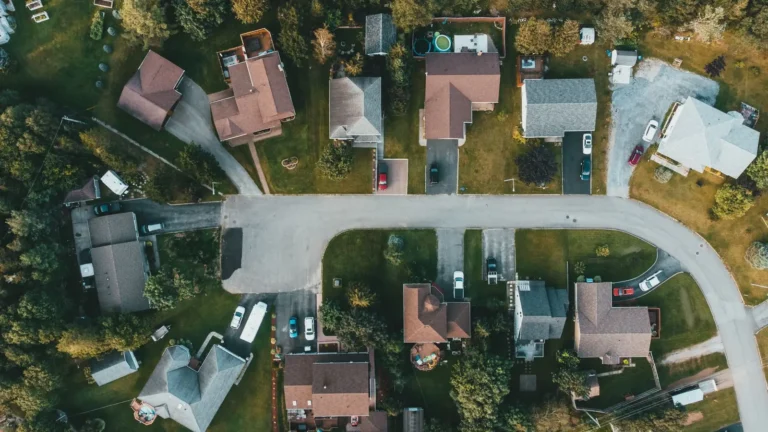
Many codes measure width at the front setback line rather than the street, so irregular lots, such as pie-shaped lots on cul-de-sacs, can have narrow frontage but adequate width where the house will sit. Others measure at the street or as an average. The definition matters most for irregular lots and lot splits.
Frontage requirements
Frontage ensures each lot has access and presence on a public street. Codes often set a minimum frontage, sometimes lower for lots on cul-de-sac bulbs. Lots without required frontage may be allowed as flag lots with a narrow access strip; see flag lots. Frontage on a private road or easement may or may not count, depending on the code.
What counts toward lot area
- Area within the lot lines, usually.
- Sometimes excluding public right-of-way within the lot.
- Sometimes excluding the access strip of a flag lot.
- Sometimes excluding wetlands, steep slopes or floodways (“net” area).
Check the definitions; a lot that looks large enough can fall short once exclusions apply.
Nonconforming lots
Older lots created before current rules may be smaller or narrower than today’s minimums. These are usually “legal nonconforming” or “lots of record”, and most codes let you build a home on them if other rules, such as setbacks, can be met, sometimes with reduced setbacks for narrow lots. However, adjoining nonconforming lots in common ownership may be merged for zoning purposes in some places. Check before buying or selling.
Minimum lot size and lot splits
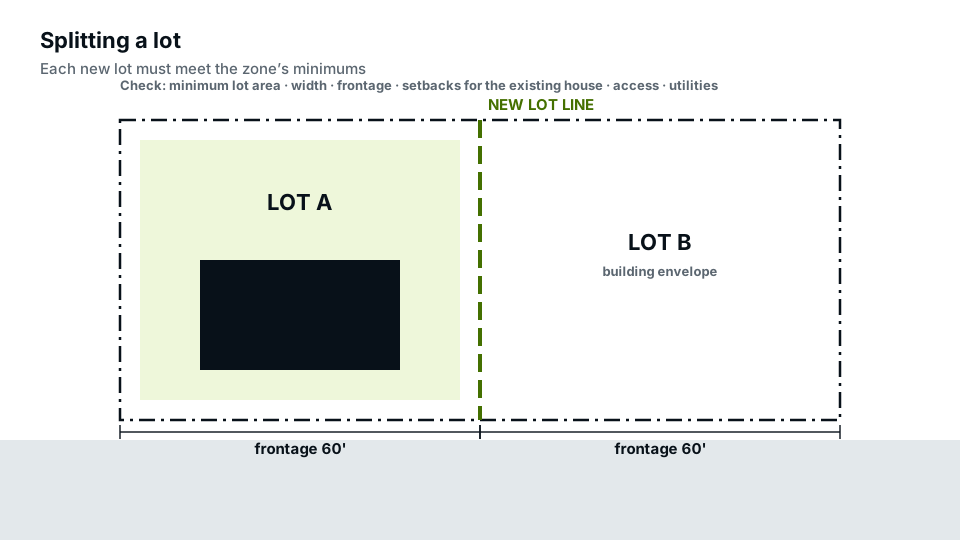
To split a lot, each resulting lot must meet the minimums. A 15,000 sq ft lot in a 7,500 sq ft district has the area for two lots, but only if both also meet width and frontage, and the existing house still meets setbacks. Many splits fail on width or frontage rather than area. See lot line adjustments for reconfiguring lots instead.
Density vs minimum lot size
Some codes control density by dwelling units per acre rather than lot size, especially in planned developments. Others allow smaller lots if open space is preserved elsewhere (cluster development). ADUs often don’t require extra lot area; see our ADU permit guide.
A worked example
A corner lot of 12,600 sq ft in a district requiring 6,000 sq ft, 50 ft width and 40 ft frontage, with 90 ft on one street and 140 ft on the other. Splitting along the longer street could create two lots of 6,300 sq ft each, 70 ft and 70 ft wide, each with 90 ft of frontage on the side street. That meets the area, width and frontage minimums. The remaining questions are whether the existing house meets setbacks from the new line and whether each lot can get sewer and water.
Corner lots and cul-de-sacs
Corner lots often have larger minimum widths because they have two street setbacks, leaving less buildable area. Lots on cul-de-sac bulbs are wedge-shaped, narrow at the street and wide at the back, so codes commonly allow reduced frontage there while still requiring the minimum width at the setback line. If your lot is either type, read the footnotes to the dimensional table.
Where to find the numbers
Minimums are usually in the dimensional standards table for each zoning district, with footnotes for corner lots, cul-de-sacs and flag lots. Lot dimensions come from your recorded plat or survey; see what is a plat.
Common mistakes
- Measuring width at the street when the code measures at the setback line.
- Counting right-of-way or easements the code excludes.
- Ignoring frontage rules for rear lots.
- Assuming an old small lot can’t be built on, or that it always can.
Getting help
Our subdivision plans service prepares concept layouts that test lot sizes, widths and frontage before you commission a survey.
Frequently asked questions
What is minimum lot size?
The smallest lot area allowed for a lot in a zoning district.
What is lot frontage?
The length of a lot’s boundary along a public street.
Can I build on a lot smaller than the minimum?
Often, if it is a legal nonconforming lot of record and can meet other rules.
Where is lot width measured?
Often at the front setback line; check your code’s definition.
Does an easement reduce lot area?
Some codes exclude certain easements or right-of-way from lot area.