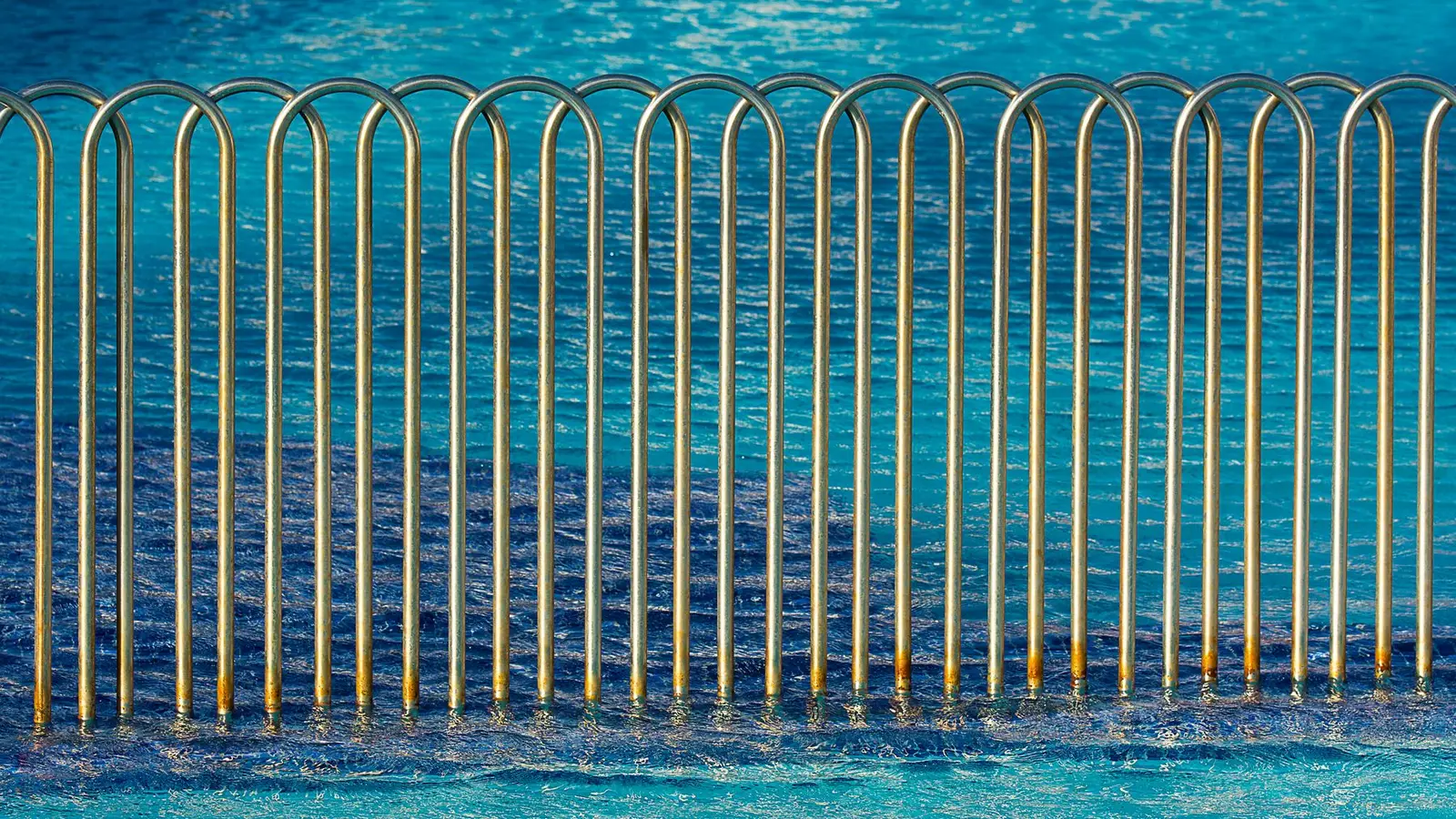

A pool barrier is the fence, wall or combination of barriers that stops young children reaching the water without an adult. The rules are detailed because small gaps, low latches and climbable rails defeat a barrier. U.S. model codes, the IRC’s pool appendix and the International Swimming Pool and Spa Code, set out the dimensions, and most local codes follow them closely. This guide explains each requirement.
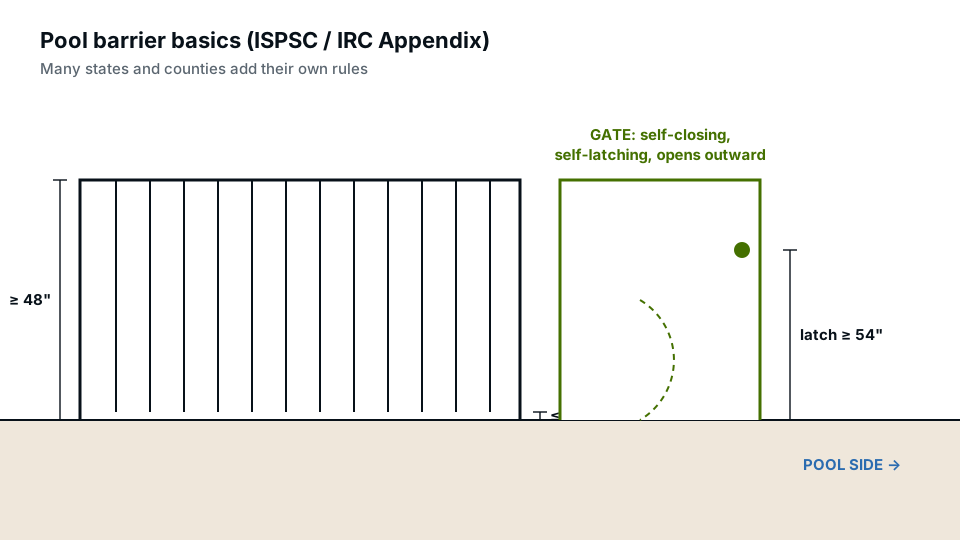
Quick answer: A pool barrier must generally be at least 48 inches high, measured on the side away from the pool, with no gap at the bottom over 2 inches and no openings that pass a 4-inch sphere. Gates must open away from the pool and be self-closing and self-latching, with the release at least 54 inches high or shielded on the pool side. House doors opening to the pool need alarms or another approved protection.
Pool barrier height and gaps
| Requirement | Typical model code value |
|---|---|
| Minimum height | 48 inches, measured on the side away from the pool |
| Gap at bottom | No more than 2 inches above grade (4 inches above a solid surface such as concrete) |
| Openings | Must not allow a 4-inch sphere to pass |
| Chain-link mesh | Mesh size limited (about 2¼ inches), smaller unless slats are added |
| Lattice or diagonal openings | Limited to about 1¾ inches |
Local codes may require more, such as 5-foot barriers in some places. Our pillar pool permit guide explains how the barrier fits into the full permit.
Climbability: horizontal members
Horizontal rails can act as a ladder. The model codes handle this by the distance between the tops of the horizontal members:
- If horizontal members are less than 45 inches apart, they must be on the pool side, and vertical openings between pickets can be no more than 1¾ inches.
- If they are 45 inches or more apart, vertical openings can be up to 4 inches.
Decorative cut-outs, ornamental features and nearby objects such as planters, air conditioners and benches can also make a barrier climbable. Keep the area outside the barrier clear.
Gates
- Open outward, away from the pool.
- Self-closing and self-latching from any open position.
- Latch release at least 54 inches above the bottom of the gate, or, if lower, on the pool side at least 3 inches below the top, with no openings over ½ inch within 18 inches of the release.
- Lockable where the code requires it.
- Larger vehicle or service gates kept locked and with the same height rules.
Gate hardware is the most common failure at barrier inspections, often because the gate doesn’t close fully from a partly open position. Test it before the inspector does.
Using the house as part of the barrier
Where a wall of the house forms one side of the pool enclosure, doors and sometimes windows opening onto the pool area must be protected. Model codes allow one of:
- an audible alarm on the doors that sounds when the door opens, with a short adult bypass;
- self-closing, self-latching doors with the release at a set height;
- a power safety cover on the pool meeting ASTM F1346;
- other means the building official approves.
Many owners use door alarms; some jurisdictions require a separate fence between the house and the pool instead. Check local rules.
Above-ground pool walls as a barrier
An above-ground pool’s wall can count as the barrier if it is at least 48 inches high and not climbable. The ladder or steps are the weak point: they must be removable, lockable or surrounded by their own barrier. See above-ground pool permits.
Spas and hot tubs
Spas and hot tubs with a lockable safety cover meeting ASTM F1346 are generally exempt from barrier rules under the model codes. Some local codes still require a barrier. See hot tub permits.
Barriers and property lines
A perimeter fence around the whole yard can be the pool barrier if it meets every requirement, including gates. Neighbour fences you don’t control are risky as part of your barrier, because they may be changed. Pool barrier fences also have to meet ordinary fence rules on height and placement; see our fence permit guide. The side with horizontal rails faces the pool, which matches the usual custom covered in which side of the fence faces out.
Showing the barrier on your pool permit
The site plan should trace the barrier around the pool, label its height and type, mark each gate with its swing direction and hardware note, and identify house doors with their protection. Add a fence elevation showing height, bottom gap and picket spacing. Our pool site plans show the barrier line, gates and door protection notes on one sheet.
Common barrier inspection failures
- Gate doesn’t self-latch from every open position.
- Gate swings toward the pool.
- Bottom gap too large after landscaping changed the grade.
- Climbable objects near the fence.
- Door alarms missing or not working.
- A gap where the fence meets the house.
Temporary barriers during construction
An excavated pool is a hazard before it is finished. Many codes require a temporary barrier around the construction area until the permanent barrier is complete and inspected. Check your permit conditions.
Frequently asked questions
How high does a pool barrier need to be?
At least 48 inches under the model codes, measured on the side away from the pool. Some local codes require more.
Which way should a pool gate swing?
Outward, away from the pool, and it must self-close and self-latch.
Can I use my house as part of the pool barrier?
Yes, if doors to the pool area are protected by alarms, self-closing hardware or a power safety cover, as the code allows.
Does a hot tub need a fence?
Under the model codes, not if it has a lockable safety cover meeting ASTM F1346. Local rules vary.
Can chain-link be a pool barrier?
Yes, if the mesh size meets the code, or slats reduce the openings, and it is at least 48 inches high.