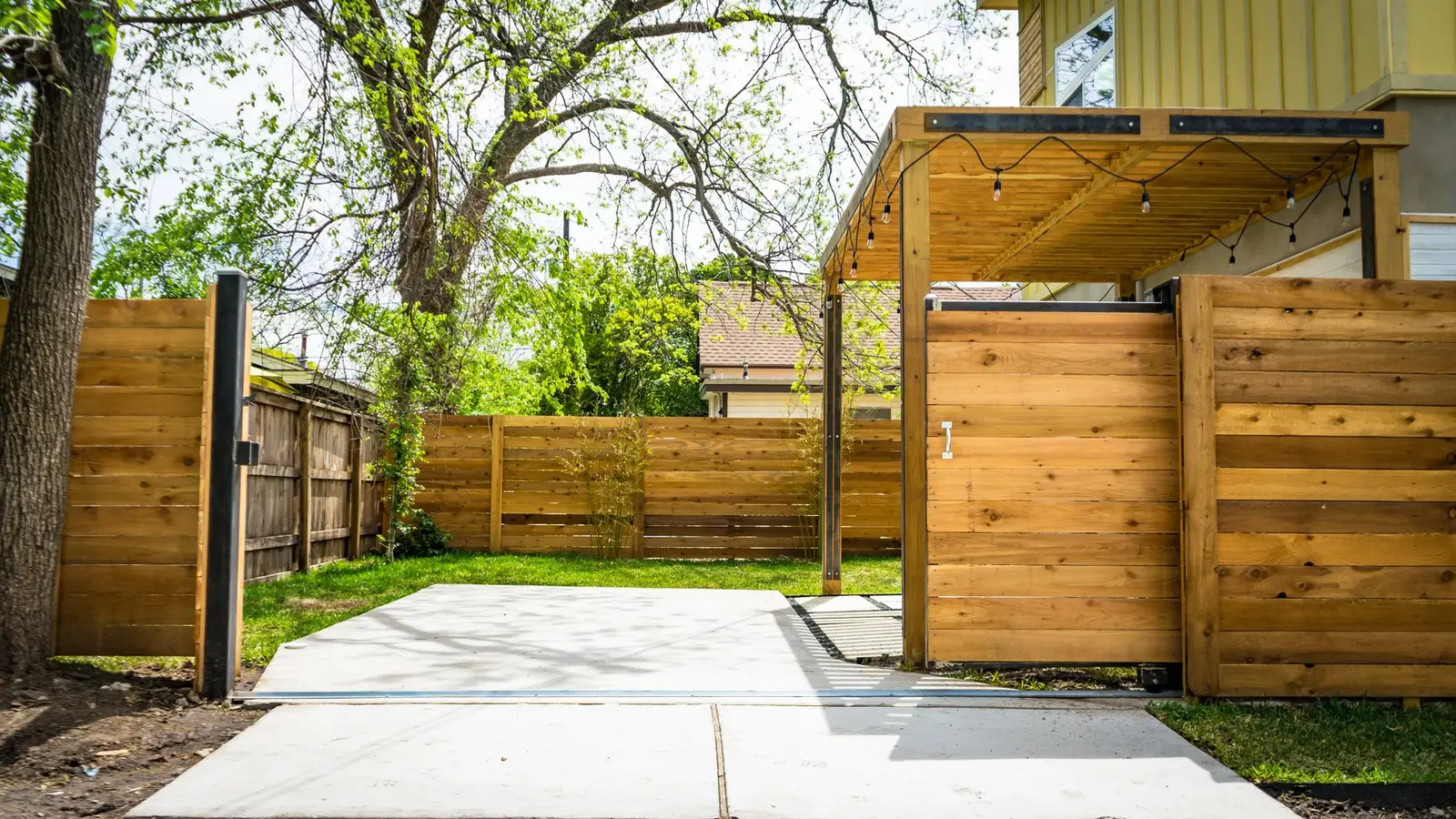

A fence permit is the approval some cities and counties require before you build or replace a fence. Under the model residential code, fences up to 7 feet tall don’t need a building permit, but many places still require a fence or zoning permit so they can check height, location and sight lines. Even where no permit is needed, the zoning rules still apply. This guide explains when you need approval, what the rules usually say and what to submit.
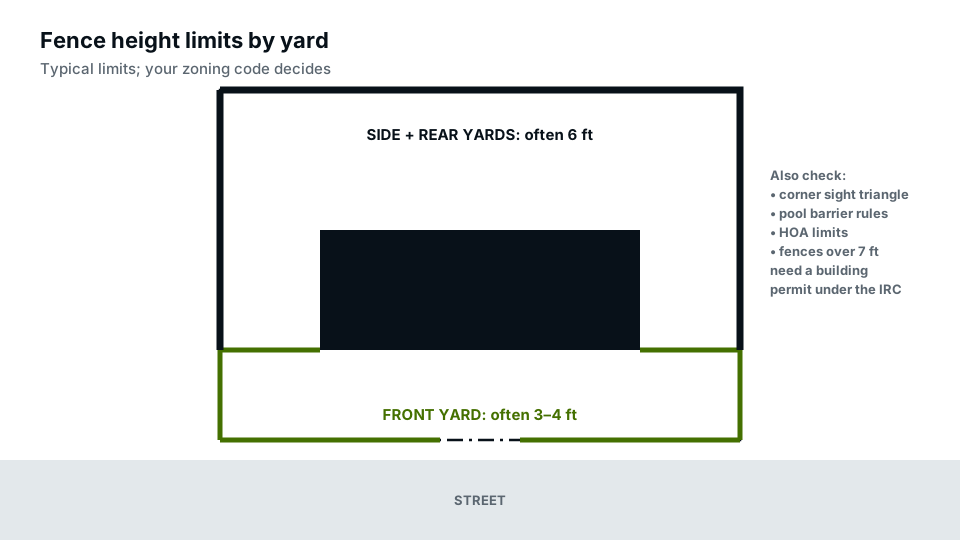
Quick answer: Many jurisdictions require a fence permit or zoning approval for new and replacement fences, even though the building code exempts fences up to 7 feet. Typical rules limit front-yard fences to about 3 to 4 feet and side and rear fences to about 6 feet, keep corner sight triangles clear, and require pool fences to meet barrier rules. Most applications need a site plan showing the fence line.
Key takeaways
- Building permit exemptions don’t remove zoning rules on fence height and location.
- Height limits usually differ between front, side and rear yards.
- Corner lots have sight-triangle rules near intersections and driveways.
- Knowing exactly where the property line is matters more for fences than almost any other project.
- Pool fences follow separate barrier rules.
Do you need a fence permit?
There are two separate questions. First, the building code: the International Residential Code exempts fences not over 7 feet high from building permits, and most local codes keep that or something similar. Taller fences, masonry walls and fences that also act as retaining walls usually need a building permit. Second, zoning: many cities and counties require a fence permit, zoning permit or zoning certificate for any new fence, so they can check height, location and materials. Some require it only in front yards, on corner lots or in historic districts. Replacing a fence in the same location may or may not count as new work, depending on the code. Our pillar guide Do I need a building permit? covers the broader exemption rules.
Typical fence height limits
Every code sets its own numbers, but the pattern is similar across much of the U.S.:
| Location | Common limit | Notes |
|---|---|---|
| Front yard | 3 to 4 ft | Often must be open style, such as picket or rail |
| Side yard (behind front of house) | 6 ft | Some codes allow up to 8 ft |
| Rear yard | 6 ft | Some allow 7 or 8 ft, especially next to commercial uses |
| Street side of a corner lot | Varies | Often treated as a front yard for part of its length |
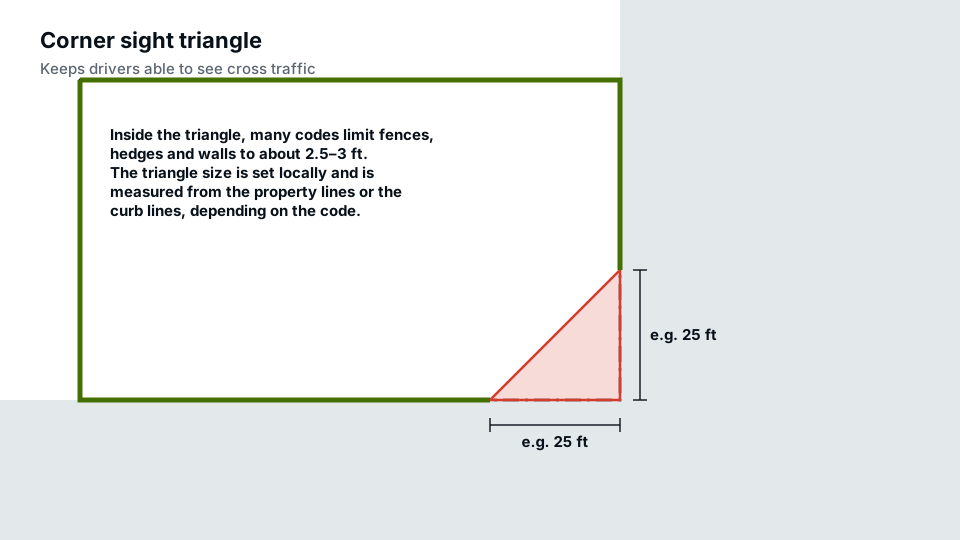
| Sight triangle | About 2½ to 3 ft | Near intersections and driveways |
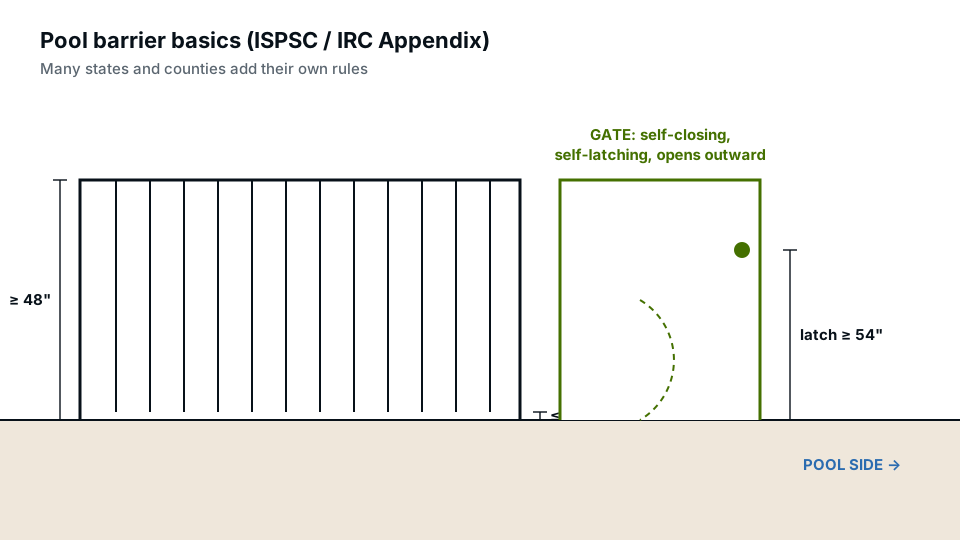
| Pool barrier | Minimum 4 ft | Separate barrier rules apply |
Our guide to fence height limits explains how height is measured on slopes, with posts and with lattice toppers.
How close to the property line?
Many codes let fences sit on or near the property line, unlike buildings, which have setbacks. Others require a small setback, especially from the street or sidewalk. The bigger issue is knowing where the line actually is. Fences are often built on the wrong side of the line because the owner relied on an old fence, a landscaping edge or a GIS map. Our guide on fence distance from the property line covers the rules and the practical choices, and how to find your property lines explains how to locate them.
Corner lots and sight triangles
On corner lots, fences, walls and hedges near the intersection can block drivers’ views. Codes create a “sight triangle” or “clear vision area” at the corner, measured along each street or property line, where anything above a low height is restricted. Driveways often have their own smaller triangles. Our guide on corner lot fence rules shows how to measure one.
Materials and style
Codes and HOAs often regulate what a fence is made of and how it looks:
- Front-yard fences may need to be a certain percentage open.
- Barbed wire, razor wire and electric fences are usually banned in residential districts or allowed only for agriculture.
- Chain-link may be prohibited in front yards in some cities.
- Some codes require the finished side to face out; see which side of the fence faces out.
- Historic districts may require approval of materials and design.
Easements and utilities
Utility and drainage easements often run along rear and side lot lines, right where fences go. Many easements allow fences but give the utility the right to remove them for access, at the owner’s cost. Drainage easements may prohibit fences that block water flow. Always call 811 before digging post holes to have underground utilities marked. Our guide on what an easement is explains the different types.
Pool fences
A fence that serves as a pool barrier must meet barrier requirements, which are stricter than ordinary fence rules: minimum height, limits on openings and climbable features, and self-closing, self-latching gates. These are checked with the pool permit. See our pool barrier requirements guide.
Fences on slopes and retaining walls
On sloping ground, fences are usually stepped or racked to follow the grade, and height is measured in a way the code defines, often from the grade at the fence line. Where a fence sits on top of a retaining wall, many codes add the wall height to the fence height, which can push the total over the limit. A combined wall and fence may also need a building permit and engineering; see retaining wall permits.
Fence types and how codes treat them
| Fence type | Typical code considerations |
|---|---|
| Wood privacy | Height limits by yard; finished side rules; post footings for tall fences |
| Vinyl | Same height rules; wind load for tall solid panels |
| Chain-link | May be banned in front yards; slats count as solid in some codes |
| Ornamental metal | Often allowed taller in front yards because it is open |
| Masonry or stone wall | Often needs a building permit at lower heights; footing design |
| Split rail or farm fence | Usually allowed in front yards; may not qualify as a pool barrier |
| Living fence (hedge) | Height limits often apply near corners and driveways |
| Electric or barbed wire | Usually restricted to agricultural zoning |
Fences in special areas
Location can add another layer of review. In historic districts, a new fence along the street may need a certificate of appropriateness, with rules on material and height that reflect the district’s character. In mapped flood hazard areas, solid fences can obstruct flood flow, so some floodplain ordinances require open designs or a permit for fences in certain zones; see building in a flood zone. Coastal, wetland and conservation areas may restrict fences to protect wildlife movement or dunes. Along state highways, the transportation department may control what is built near the right-of-way.
Agricultural and rural properties
Rural and agricultural zones often have far looser fence rules: livestock fencing, barbed wire and taller fences may be allowed by right, and some counties don’t require any permit. Some states also have fence laws that set out how neighbouring landowners share the cost of boundary fences for livestock. If your land is rural, check both the county code and any state fence statute before building a long boundary fence.
What to submit for a fence permit
- The application form, with owner details and parcel number.
- A site plan showing the property lines, house, driveway and the fence line.
- Fence height and material for each run, and gate locations.
- Distance from the fence to property lines and to the street or sidewalk where it matters.
- Sight triangles on corner lots and at driveways.
- Easements along the fence line.
- A product sheet or simple elevation of the fence style.
- HOA approval if required.
Our fence permit site plans show all of this on one sheet, colour-coded by fence height.
Common reasons fence permits are rejected
- Fence too tall for the front yard or street side.
- Sight triangle not shown on a corner lot.
- Fence line drawn without property line dimensions.
- Fence in a drainage easement where fences are prohibited.
- Pool fence that doesn’t meet barrier rules.
- No elevation or product sheet showing height and style.
Neighbours and shared fences
A fence on the property line may be shared, and some states have “fence laws” or “good neighbour” statutes that address shared costs and maintenance, mostly in rural or agricultural contexts. Talking to your neighbour before building avoids most disputes, and a written agreement helps if the fence straddles the line. Remember that a neighbour’s agreement doesn’t change zoning rules; a 7-foot fence that exceeds the limit is still over the limit.
HOA fence rules
HOAs often control fence style, height, colour and material, and some prohibit front-yard fences altogether. HOA approval is separate from the city’s fence permit, and HOA rules can be stricter. Submit the same site plan to both.
Fence posts, footings and wind
Most residential fences under the exemption height don’t need engineered footings, but they still need to stand up to wind. Solid privacy fences catch far more wind than open designs, so post spacing, post size and embedment depth matter. A common rule of thumb is to bury about a third of the post length, set in concrete or compacted gravel, but follow the manufacturer’s instructions for vinyl and metal systems. Fences over 7 feet, and masonry walls, usually need a building permit with a post or footing detail, because the code then requires them to be designed for wind loads.
Fence permits for contractors
Fence companies often pull permits for their customers. A fast, repeatable site plan for each job, with lot lines, fence runs colour-coded by height, gates, easements and sight triangles, keeps approvals moving in busy seasons. Our contractor services provide fence site plans on a repeat basis.
Replacing an old fence
Many codes treat full replacement as a new fence, so it must meet current height and placement rules even if the old one didn’t. Repairs, such as replacing a few boards or a post, are usually exempt. Before replacing a long-standing fence, confirm it was actually on your side of the line; old fences are not reliable boundary markers.
Step-by-step
- Find your zoning district’s fence rules and any HOA rules.
- Locate the property lines from a survey, plat or markers.
- Plan fence runs by yard, with heights and gates.
- Check sight triangles, easements and pool barrier needs.
- Prepare the site plan and submit the permit if required.
- Call 811, then build within the approved plan.
- Schedule any final inspection required.
Frequently asked questions
Do I need a permit to build a fence?
The model building code exempts fences up to 7 feet, but many cities require a fence or zoning permit for any new fence. Check locally.
How tall can a fence be in a front yard?
Commonly 3 to 4 feet, sometimes with a requirement that it be partly open. Check your zoning code.
Can I build a fence right on the property line?
Many codes allow it, but you need to know exactly where the line is. Building slightly inside your line avoids disputes.
Do I need a survey for a fence permit?
Not always. Many offices accept a site plan from the plat, but a survey is wise where lines are uncertain.
Does replacing a fence need a permit?
Often, if it is a full replacement. Small repairs usually don’t.
Is a fence permit inspected?
Some offices inspect the finished fence for height and location, and pool fences are almost always inspected. Many simple fence permits are approved from the site plan alone.
Can my HOA stop me from building a fence?
If your covenants give the HOA approval rights, yes. HOA rules are separate from the city’s rules.