
An ADU feasibility check answers one question before you spend money on design: can an accessory dwelling unit be built on this lot, and roughly what will shape it? Zoning, lot dimensions, utilities, access, trees and private restrictions can each rule an ADU out or change its size and position. This checklist groups the questions so you can work through them in an afternoon, and shows where to find each answer.
Quick answer: ADU feasibility depends on whether zoning allows an ADU on your lot, whether the size you want fits within setbacks, coverage and height limits, whether water, sewer or septic and electrical capacity are available, whether emergency access works, and whether HOA rules, easements or protected trees get in the way. Check each before paying for full drawings.
Zoning questions
- Is an ADU allowed in my zoning district? Check the ADU section of the zoning code; see how to find your property zoning.
- Is it allowed by right or does it need special approval? By right is faster.
- Is there a minimum lot size? Some codes require one; some state laws limit them.
- What is the maximum ADU size? A fixed limit or a share of the house.
- What are the setbacks and height limits for my ADU type?
- Is extra parking required? Or is the lot exempt?
- Is owner occupancy required? This affects future plans and financing.
For the full permit process, see our pillar ADU permit guide.
Site questions
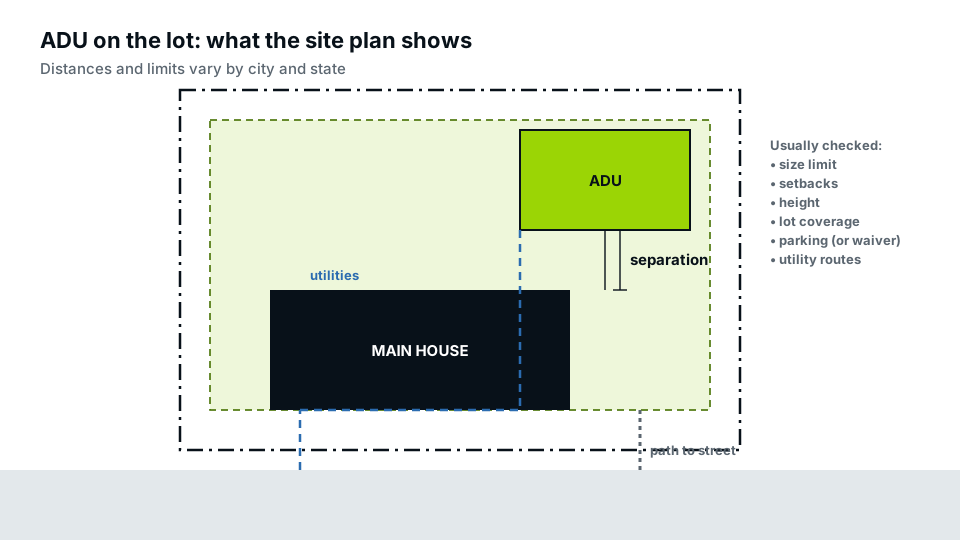
- Where is the buildable area? Draw setbacks on your plat to see the space left.
- Are there easements? Check the plat and title documents; see what is an easement.
- How much lot coverage is left? See lot coverage.
- Are there protected trees? Large trees can limit placement and trenching.
- Is the lot steep, wet or in a flood zone? These add cost and review; see how to find your flood zone.
Utility questions
- Is the lot on public sewer or septic? Septic capacity may not support another unit.
- Where is the sewer connection, and does it slope the right way? Rear ADUs may need a pump.
- Is the electrical service large enough? A panel or service upgrade may be needed.
- Are separate meters required or desired? This affects cost and connection fees.
See ADU utility connections for options.
Access questions
- Can firefighters reach the ADU? Check maximum distance or path width rules.
- Is there a separate, safe entrance path?
Private and financial questions
- Do HOA covenants or deed restrictions prohibit a second unit? Some state laws limit HOA restrictions on ADUs, but check.
- What fees apply? Permit, impact and connection fees can be significant; ask the city for an estimate.
Where to find the answers
| Question area | Source |
|---|---|
| Zoning and ADU rules | City or county zoning code; planning office |
| Lot dimensions and easements | Recorded plat, survey, title documents |
| Flood zone | FEMA flood map; county GIS |
| Sewer and water | Utility provider; public works |
| Septic capacity | Health department records |
| Electrical service | Your panel label; an electrician |
| Fire access | Fire marshal or fire code section |
| HOA | Covenants and design guidelines |
Turning ADU feasibility answers into a sketch
Once you have the numbers, a simple feasibility site plan brings them together: lot lines, existing buildings, setbacks, easements, trees, utility routes and the largest ADU footprint that fits. It quickly shows whether a detached, attached or conversion ADU works best; see detached vs attached ADU. Our ADU permit plans can start with this feasibility layout before moving to full drawings.
Red flags that often end an ADU plan
- A septic system that can’t be expanded.
- No room within setbacks for the minimum useful size.
- A deed restriction or HOA rule that bars second units, where not overridden by state law.
- Fire access that can’t be achieved without sprinklers you can’t afford.
- A steep or flood-prone site with high foundation costs.
A worked example
Take a 50 × 140 ft lot in a district that allows a detached ADU up to 800 sq ft, with 5 ft side and rear setbacks for ADUs, 10 ft separation from the house and 40% lot coverage. The house footprint is 1,500 sq ft and sits 60 ft back from the rear line. Lot area is 7,000 sq ft, so coverage allows 2,800 sq ft: 1,300 sq ft is left. The rear yard, after the 5 ft setbacks and 10 ft separation, gives a 40 ft wide by 45 ft deep buildable area. An 800 sq ft single-storey ADU fits easily. The remaining questions are the sewer slope to the street, the electrical service size and the fire access distance from the street, which on a 140 ft deep lot may be the deciding factor.
Pre-application meetings
Many cities offer pre-application meetings or ADU counselling. Bring your feasibility sketch and list of questions. Fifteen minutes with a planner can confirm assumptions, reveal local rules and save a design round.
Financing and timing
Lenders may ask for feasibility information, cost estimates and permits before funding. Owner-occupancy rules affect some loan types. Build in time for design, permit review and utility work, which often takes longer than construction itself.
Next steps once the answers look good
When the checklist comes back positive, the next steps are choosing the ADU type, commissioning a survey if setbacks are tight, and preparing the drawing set. Keep your answers in one document, with sources and dates, so your designer and the permit reviewer work from the same assumptions. If rules change during design, which happens often with ADU laws, check which version applies to your application.
Frequently asked questions
How do I know if my lot can have an ADU?
Check zoning eligibility, then whether an ADU fits within setbacks and coverage, and whether utilities and access work.
What is an ADU feasibility study?
An early review of zoning, site, utilities and costs, often with a sketch site plan, before full design.
Can a septic system support an ADU?
Only if it has capacity or can be expanded. The health department decides.
Do I need a survey for ADU feasibility?
Not always for the first check, but often before design when setbacks are tight.
Can my HOA stop an ADU?
Possibly, unless state law limits HOA restrictions on ADUs. Check both.